Discretionary expenses are expenses for thing that you don’t absolutely need in order to survive or run your household. They are often optional (some would even argue unnecessary) expenses that mainly enhance your day-to-day life and make it more fun. Think about dinners at the restaurant, holidays and a trip to the cinema. To give a definition of a discretionary expense, it:
is an expense of a variable amount that you have more or less complete control over;
might or might not have a regular time interval;
is not needed for day-to-day living;
you can cut out all together relatively easily.
Discretionary expenses are usually the type of expenses that people cut back on first during tough financial times, and also the first ones that increase again when their economic situation improves. That coffee you get every day at Starbucks on your way to work? That’s a discretionary expense: you have complete control over it, you don’t need it for day-to-day living, and you can cut it out all together and make your own coffee when you get to work or bring one in from home in a thermos flask. Continue reading “Step 11: Identify your Discretionary Expenses”→
In step 9 we looked at fixed expenses, but apart from these regular payments of a set amount, you most likely also have regular expenses which vary from one month to the next: your so called variable expenses. Indeed a variable expense generally:
is an expense of a variable amount that you have some control over
has a regular time interval
is needed for day-to-day living
you can cut down by making small lifestyle or behavioural changes.
An example of variable expenses include groceries: you need to eat for day-to-day living, they have a regular time interval, as you probably go to the supermarket several times a month but contrary to your fixed expenses, you have some control over the amount on your grocery bill. Continue reading “Step 10: Identify your Variable Expenses”→
Our next step of the 100 steps mission to financial independence is to set yourself a goal for what you would like your net worth to be in six months. This gives you an excellent target to work towards to during the mission. Although you’ll probably find that your net worth doesn’t change dramatically in this half a year, 6 months is a good time frame to start with as it is long enough to see substantial changes and the effects of goal setting, yet short enough not to forget about it or lose track.
You can set yourself a goal for your net worth by either stating a specific amount, or alternatively by setting a percentage by which to increase your income. If you set a specific amount as your target and keep that the same every six months, with time as your net worth increases and as it should become easier to achieve the same target, you might not be achieving as much as you could. Alternatively, if you set yourself a target of certain percentage increase it means that your net worth target increases more as your net worth itself increases.
In this 6th step, you are going to determine your overall financial starting point by calculating your net worth. I know the words “calculate” and “net worth” might be putting you off, but this step is a lot easier than it might sound, as we have already done all the preparation work in the last few steps by digging up financial statements and creating our assets and liabilities lists in step 4 and 5.
Your net worth basically indicates what would happen if you decided to sell all of your possessions and pay off all of your debts today: would you any have money left over or would you still be in debt? How much money would you have left over or how much money would you still owe? Your net worth is an easy sum of your total amount of assets minus your total amount of liabilities. Continue reading “Step 6: Calculate your Net Worth”→
Now we know exactly what our debts (or liabilities) are, in this step we are going to look at what our possessions (also known as assets) are. Assets add a positive value to our financial status: they are the things that we own and therefore add a positive value to our balance sheet.
Making an overview of all your assets, will not only allow you to know exactly how much you own at present, it also gives an insight into what you might be able to do in order to increase the number or value of your assets, thereby increasing your financial value.
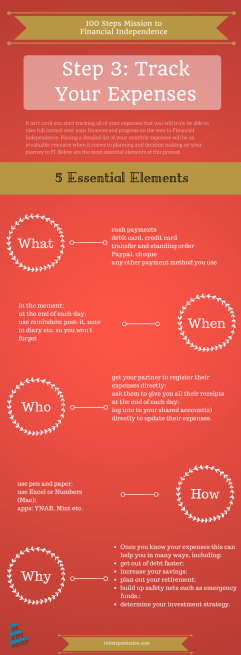
This post describes the details of tracking your expenses on your journey to Financial Independence. To see how I personally started tracking my money, check out the from level 2 to level 3 post: Tracking my expenses, which includes practical ideas on what, when and how to start this new habit.
Now that you have your goals clear of where you would like to get to financially, we are first going to look at what happens to your money and how you are spending it. Once you know what your current spending patterns are, you can evaluate whether they align with your financial goals and whether you need to set aside more or less money for your goals.
Obviously your spending changes from week to week and month to month as you don’t always need new clothes, a car that needs fixed and even your weekly shopping bill is different every time you go to the supermarket. Therefore, in order to find out where your money goes, you are going to track your spending. By registering your expenses you are furthermore becoming more conscious of spending your money, which is likely to result in a slight decrease in your expenditure in general. 🙂
There are various tracking options available. There is the good old notebook that you can carry around with you to register all your expenses in, but there are also (paid and free) online options and apps, such as YNAB (You Need a Budget), Mint and EveryDollar. You could also create your own spreadsheet in a programme such as Microsoft Excel. The advantage of the online programmes / apps is that they will allow you to plunk in any expense at the very moment that you are making a payment and some allow you to import your bank statement too. They can often give you reports depending on how you’ve set up categories, so have a look around and decide what you prefer and what you feel works best for you. That said, don’t use “having to find the best option” as an excuse not to start. If you don’t have time to investigate the options today, just start registering your expenses on paper and transfer them once you’ve made a decision on your definitive method of tracking.
Step 3 – Track your expenses – in detail
Starting today, keep track of everything that you spend, no matter how small or insignificant the expense might seem. This is not just cash, remember to also include any debit or credit card payments, standing orders and any other form of payment.
Record your expenses in one place, don’t worry about whether or not it is the perfect system and whether it is set up in the best way possible. The most important thing for now is to just start and then with time find out what system works for you.
When you get a chance, investigate alternatives to register your expenses, be that digital or in analogue format. Remember that if you want to use a digital expenses tracker on different devices, such as your computer, tablet and / or phone, you’ll want to make sure that it works on all of them and that any updates get synced automatically.
Settle for an option that you feel is easy to use and that fits in with what works for you. If you choose a system that you don’t feel motivated to use, you are unlikely to update it and you will most likely stop tracking your expenses after just a few days.
Log your expenses for at least three months, although it is a good habit to keep up in general even after these initial months, to see how your expense patterns change with time and to keep track of your money in general. Especially yearly expenses and emergency expenses might otherwise not become clear.
Add this step to a post-it, card, your mobile phone or journal, so you are reminded of your new task. You might also want to set yourself an alarm to remind you to write down your expenses twice a day to do it there and then, as if you leave it until the next day, you are likely to forget some of them.
If you ever forget to register an expense, don’t worry and most importantly: don’t give up on this entire step. Just accept that you forgot and continue again the next day. It requires quite a bit of time to get used to this new habit to keep a record of everything you spend, so it is likely you will forget now and again. That’s okay, just keep going!Obviously your spending changes from week to week and month to month as you don’t always need new clothes, a car that needs fixed and even your weekly shopping bill is different every time you go to the supermarket. Therefore, in order to find out where your money goes, you are going to track your spending. By registering your expenses you are furthermore becoming more conscious of spending your money, which is likely to result in a slight decrease in your expenditure in general. 🙂
To see how I personally put these ideas into action and set my own financial goals, check out the level 2 post: My Financial Objectives, which includes a free download of a worksheet to set your own financial targets!
One of the most important steps you can take towards becoming financially independent is making clear what your goals are. There is nothing more powerful than having a specific end objective that you are working towards to. Without stating your goal it is easy to give up after only a few initial attempts as you forget why you started this journey in the first place and because you have no way of measuring whether you are any closer to your target.
Numerous studies have furthermore shown that if you write down your goals you significantly increase your chances of ultimately achieving them, with some studies saying the likelihood of success increases by as much as 50% or more. So it is definitely worth stating your goals if you want to really achieve success on this mission! Continue reading “Step 2: Set Financial Goals”→





 100 Steps Mission